Proven Findings. Not Probable Ones. Verified, Not Generated.
Gofai's Large Metadata Model uses three coordinated agents, Neural, Symbolic, and Orchestration, to catch what generation alone can't. Nothing ships until it's been verified.
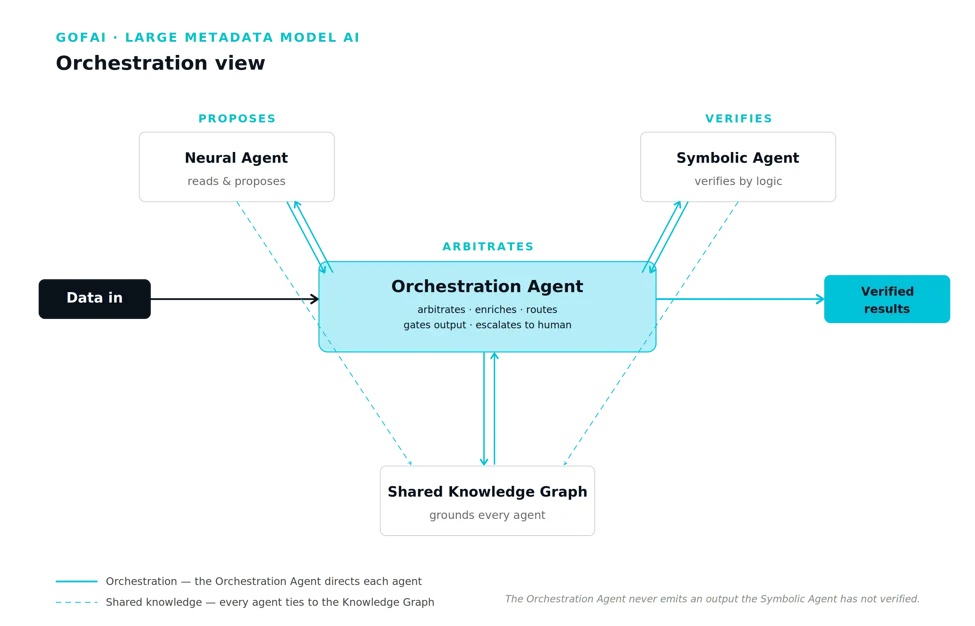
Most AI tools generate an answer and hope it's right. Gofai doesn't guess. A Neural Agent proposes, a Symbolic Agent verifies by logic, and an Orchestration Agent arbitrates between them, limiting every output to what's provably correct. If the two agents can't agree, the Orchestration Agent escalates to a subject matter expert instead of returning an unverified answer. The result: proven answers, by architecture, not by promise.
Get the White Paper
How Gofai's Neural, Symbolic, and Orchestration agents force AI to prove itself — the full breakdown.
Learn why coordination between three specialized agents delivers findings with built-in traceability, so every data integrity claim carries its own evidence.
What's Inside
See how Gofai's three agents—Neural, Symbolic, and Orchestration—make every finding provable.

How the agents divide labor
The Neural Agent proposes, the Symbolic Agent verifies by logic — two fundamentally different ways of checking work, working in tandem.

Why nothing unverified ships
The Orchestration Agent arbitrates every disagreement and escalates to a subject matter expert rather than guessing.

A framework for evaluating any AI vendor
A practical way to assess hallucination risk in AI tools you’re already considering.